

Plenary
Methods and Challenges for Wideband, Multi-function Arrays
Radar, EW and communication systems are common throughout C, S, X, to Ku-band. Large platforms have multiple phased array systems while smaller platforms may be limited to only a single system due to size, weight, and cost issues. The benefits of a single, wideband system that can support multiple functions are clear and the need to combine functions into a single system has never been higher. Yet these systems are not prevalent today. This presentation discusses the key technologies and challenges for wideband phased arrays, including power amplifier efficiency, wideband beam steering, element sizing constraints, packaging and thermal considerations and cost. It will cover the latest advancements in these areas that will make wideband arrays realizable in the future.
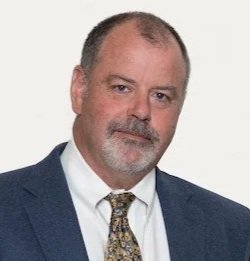
Chris Ison is a Vice President of Engineering for MACOM’s MMIC business unit. Chris joined MACOM as part of the ENGIN-IC acquisition in 2024 and in his role supports advanced products for phased arrays including MMICs, front-end modules, and array cards. Prior to joining MACOM, Chris was a Founder of ENGIN-IC, formed in October, 2014 and served as President and COO. Chris has more than 35 years of experience in the Defense and Space RF-MW industry. He joined REMEC Defense and Space in 1987 and worked there for 27 years in position of increasing responsibility. Starting as a design engineer, Chris eventually became Director of Engineering, Vice President of Advanced Development, and General Manager. In these positions, Chris developed microwave architectures and modules that supported many advanced Radar, Electronic Warfare (EW), and Communication systems, including Integrated Microwave Assemblies and RF Subsystems for the F-35, F-18, F22, F-16, Global Hawk, AARGM, AMRAAM, and RC-135 Platforms. Products ranged from wideband receivers, complex phased arrays, to entire RF front-end subsystems. In addition, Chris served as the General Manager for REMEC Defense and Space’s MMIC operation in Richardson, Texas for ten years and was instrumental in growing the business through the integration of advanced MMIC technology into higher level microwave modules. Chris graduated from Carnegie Mellon University with a BSEE degree in 1987.